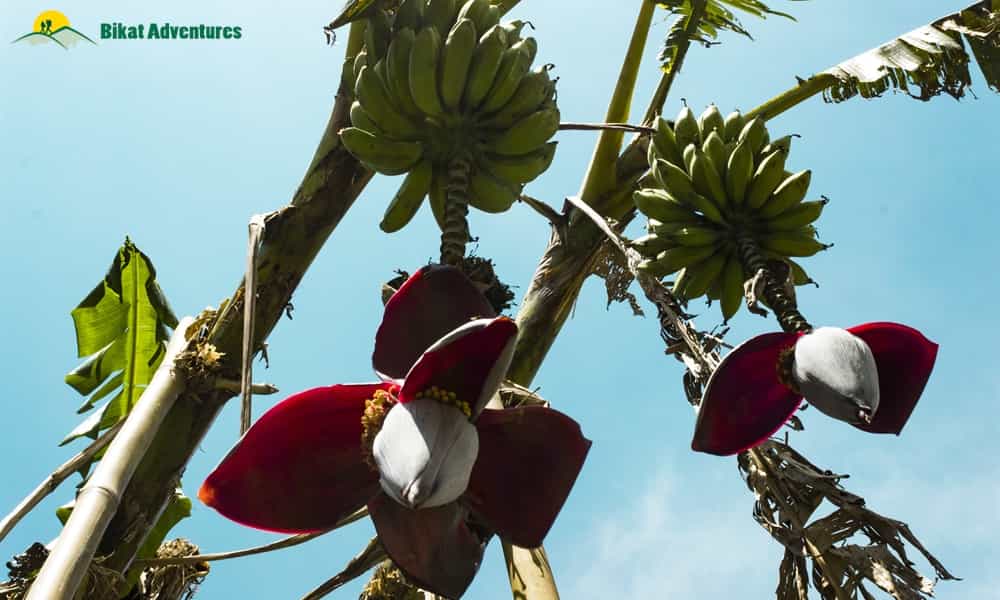
Banana trees found along the trail
The trail to Everest Base Camp also had beautiful forests in the lower valleys, but the region is much drier overall, and that limits the flora and fauna. In comparison, Annapurna’s trail brought with it a sense of freshness that couldn’t go unnoticed.
2. Price
If budget is a concern for you, then this is another key point. Annapurna Base Camp, when compared to Everest Base Camp, is much more friendly to trekkers who are very price conscious. The reason is three-fold: location, transportation cost and duration.
In terms of transport, getting to the trailhead of ABC is much less expensive because it can be reached by road. You can book a fairly cheap bus from Kathmandu to Pokhara, and from there hire a shared cab to Nayapul, the start of the trail. For EBC, on the other hand, the trail begins in Lukla, a village with no road connectivity that is only accessible by flight. For SAARC members, that round-trip flight is roughly 17,000 INR and 24,000 INR for other foreigners.
The location of EBC also increases costs. For the teahouses where you stay along the way, the only way to get supplies (like the food you eat), is via a flight to Kathmandu, and then have porters carry it up on their backs. The further up you hike, the further from Lukla you get, the longer the trip is for the porters and the more lodges need to pay them. By the time your reach the upper lodges, like Gorakshep and Lobuche, the price of boiled eggs on the menu skyrockets to 500 NPR and cooked package of Maggi is 660 NPR. Since Annapurna’s trailhead is highly accessible by road, the transport of the items is less costly, and the less-remote lodge locations (4 days maximum from the trailhead) means a much more pocket-friendly menu.