Kedarkantha vs Dayara Bugyal:
The Ultimate Winter Trek Showdown
I remember my friend, on his first trek ever, asking the guide at Raithal, “ Bhaiyya, trail is easy na?”, the night before our Dayara Bugyal trek in December 2023, and most of us started laughing.
Ironically, he ended up being the first one to reach the small Shivling placed atop a rock at around 12,000 ft, as his fear of inexperience mixed with over-preparedness made him rush to the top, surprising all of us.
That night, over a campfire, the guide mentioned, “You’re quite lucky that your first trek was Dayara, especially when the trail is almost empty and the snowfall. On most winter treks, like Brahmatal, Kuari, or Kedarkantha, the snow on the trail would have made your lungs and calves work a little for the views.”
And just like that, the next winter, we booked our Kedarkantha trek, and needless to say, the experience was worth the effort on the trail, this time, on plenty of snow.
Just like Dayara Bugyal, Kedarkantha is a lot of joy, but in a totally different way.
So, if you are looking for your next winter trek in India and are confused between Kedarkantha and Dayara, let me break it down to you the best I can, so you can make an informed decision this year
A scenic summit climb v/s vast, snowy alpine meadows, two of the very scenic winter wonders Uttarakhand offers you.
Which is the best winter trek (for you) amongst the two? Let’s find out.
The Terrain
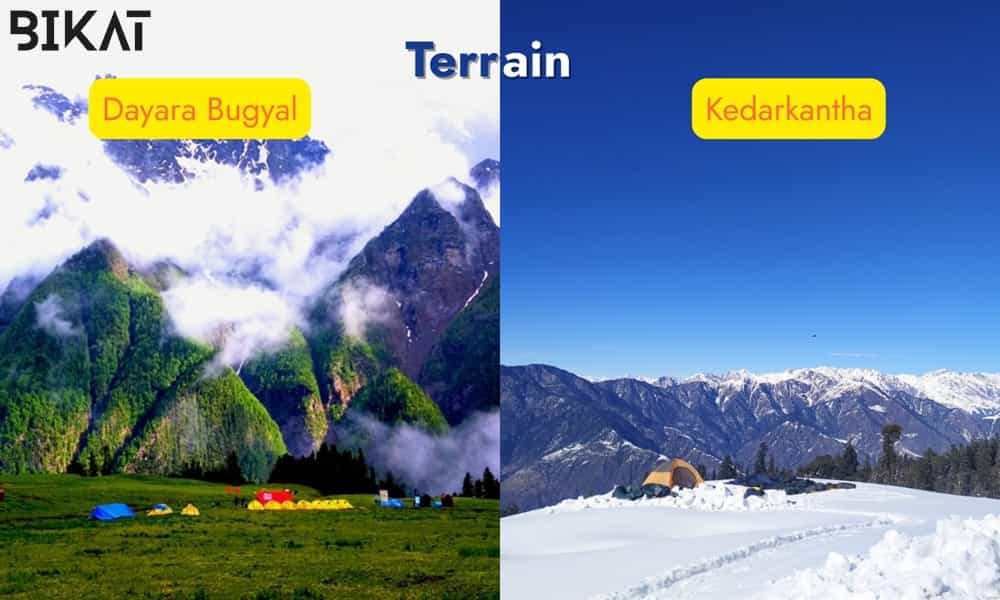
If there is something where these two treks fundamentally diverge, it is the terrain, the very ground that we walk on.
Walking on acres of grasslands, at times covered in complete snow for days, can get a little tricky on the mind, just like walking up to the summit on a cold, dark night surrounded by some of the highest mountains in the Himalayas.
A clear understanding of the terrain can help you decide if you want a good ‘workout’ to the top, or a steady walk in the plains.
Uttarakhand | 12500 ft| 5 days
Kedarkantha offers you a traditional, true summit climb, which makes you feel ‘ I am on top’ when you reach the top.
The trail is a mix of steep ascents, rocky patches, and walking through dense pine and oak forests, followed by open ridge walks.
These same trails, in winter, will make you work every stride, with a fresh round of snowfall making you walk in knee-deep snow on some occasions.
At higher campsites, more often than not, you encounter freezing temperatures. Ensure you request hot water if it’s not readily available.
The powdery deep snow means a summit push often demands gaiters, microspikes, and headlamps, with your 4 layers to protect you from the harsh cold winds.
This trek gives you the full, gritty spectrum of a winter trek in India—cold, effort, and a hard-won reward. The views from the top, showcasing the Swargarohini and Bandarpoonch peaks, are sharp and commanding after the campsite on day 1.
The white-blanketed clearings at 3 AM are something that should be experienced to truly appreciate the 6 AM sunrise.
Yes, it may sound metaphorical, but if you get to the summit on schedule, it will feel like the best winter trek in India, until you go for something bigger.
If you want the classic thrills of a climb and moderately steep terrain, Kedarkantha is where you need to head this winter.
Uttarakhand | 12000ft | 4 days
Imagine a winter where you just stroll on the mountains for days, without any pressure to ‘climb’ or ‘summit’ them. If the thought itself is as exciting as it is enticing, then imagine being there, doing that!
Dayara Bugyal can be your/your friend’s first-ever winter trek, and it will be the perfect introduction to a low-risk, high-altitude trekking experience. With a friendlier gradient, forgiving terrain, and manageable distances each day, you get to do what you want and gain some much-needed experience for your future winter treks in India.
The trail is a very slow, gradual walk to the top, and the ‘top’ here technically refers to the vast plains you’d encounter once you walk a few good, silent hours in the rhododendron forests.
Once you start your day from camp 1, you’d be treated to a view that would otherwise be hard to come by on most treks. Right in front of your campsite on day 2, your lens can capture as far as your eyes can see, and then some: The skies open up to an amphitheatre of high-altitude peaks: Bandarpunch, Srikanth, Jaonli, Black Peak, and Gangotri I.
If you are not the one for photography, no problem. Trace your steps for a few hundred meters, and go for long, mindful walks on the meadows, interrupted occasionally by a few green/white hilltops with thick snow, depending on the weather.
The joy here is the calmness you find anywhere you step. There are almost no trees, confusing pathways, or even tricky mountain sections, so the chances of you exploring without getting lost are reasonably high. Make good use of it.
So, if you plan to take it slow this year and opt for a trek that offers all the winter-adventure elements, sans the risky bits, Dayara Bugyal can become your best winter trek of the season.
The Ground Reality
Your fellow trekkers and the whole set-up can define your experience.
In that sense, Kedarkantha is the more popular of the two.
Along with Brahmatal, Kedarkantha is one of the most popular winter treks in India for a reason.
This means you’d often encounter other groups and individuals.
Campsites, especially during the December and January peak season, can be bustling, and it can become a challenge for those who prefer solitude and moments with nature.
But if you are an extrovert who thrives on social energy and doesn't mind a shared experience, this is definitely for you.
For solitude, aim for the edges of the season (late November or Post mid-February)
In comparison, Dayara sees significantly fewer trekkers. The sense of solitude can be found in many secluded parts of the plains, especially during the moonlit, starry nights.
A sense of belonging to nature is profound. You'll often feel like you have the entire meadow to yourself. This is the trek for those who want to escape the noise of the outside world and connect with the mountains on a more personal, quiet level.
Dayara, as we said, is just ‘relatively’ less popular.
If you prefer absolute solitude, monitor the weather, and keep in touch with your guides a month in advance once you book your dates, and start your trek immediately after the first round of snowfall.
Difficulty & Accessibility: Who are These Treks For?
If we are being brutally honest about who can and should do these treks, then
Kedarkantha is the best winter trek in India for an Adventurous Beginner.
Labelled "easy-moderate”, Kedarkantha is the perfect first Himalayan summit. It's demanding but also not too tough, making it achievable for anyone with an average fitness level.
But the summit day will test your lungs and legs, although it's not technically complex.
If you've done a few day hikes around your home state and can handle a sustained climb, you can easily complete Kedarkantha. It's the best winter trek for someone who wants a tangible, challenging goal.
On the other hand, Dayara is, without a doubt, the gentlest introduction to high-altitude winter trekking. The gradients are forgiving, the distances are manageable, and there is no intimidating summit push. It is ideal for absolute beginners, families with older children, or anyone who prioritises a scenic, less strenuous experience over a physical conquest.
The Final Showdown: How do you Pick?
Don't overthink this. It’s simple.
Choose KEDARKANTHA if:
- You need a summit flag in your Instagram picture and the bragging rights
- You enjoy a physical challenge and want to push your limits
- You don't mind relatively big crowds and enjoy a social trekking atmosphere
- The idea of a steep, snowy climb excites you more than a happy winter vacation
Choose DAYARA BUGYAL if:
- Your idea of a happy winter vacation is an endless, untouched field of snow
- You are a beginner, or simply prefer a peaceful, meditative walk in nature
- You are a budding photographer seeking breathtaking, panoramic landscapes
- You want to escape the crowds and find true solitude in the mountains, either alone or with your family
Important Question: Why Not Both?
Yes, that is the perfect attitude, if you want to wet your feet in the snow and get into the world of mountaineering (pun intended)
Here is a secret: You don't have to choose just one.
If you have the time for it, you can do one by December and the other by February.
If not, pick one for each winter, and experience the real magic of the snowy trails and Himalayan terrain for two continuous years.
These two treks are not rivals; they complement each other. They represent two different, equally unique, beautiful sides of the Himalayan experience, which can make you a lifelong fan of the beautiful outdoors, much like me 😀
So, whatever you decide, we hope you have a great time on the trails and come back safely with a lot of memories this winter season.
After you book, and before you pack for your next winter adventure, make sure you don’t make these 12 mistakes on the snowy trails.
India may not have the Alps’ or Alaska's infrastructure yet, but it has something purer: The feel of the mighty Himalayas.
You’ll learn to read snow, respect altitude, and find rhythm in your strides.
At the end of it all, whether you stand atop Kedarkantha’s summit or watch the sunrise from Dayara’s frozen meadows, you’ll realise the mountain never needed to choose between beauty and challenge.
It gives both in equal measure.
Remember, there is no ‘winner’ between these two treks. Whatever you choose, you are the winner here!
Happy trekking!