Note: Going by this argument, toilet pits at campsites (even when they are dug away from water sources) are ecologically harmful, especially on over-crowded Himalayan trails. We will be discussing more about this later on in the article.
Find out what is done with the waste collected at each campsite. This may require you to do a little bit of digging.
Ideally, the waste should be carried from one campsite to the next and disposed after reaching the base village or civilization. Sometimes, Operators bury this waste at the campsites to avoid carrying extra load on the trek.
Next, look at the model of Camping a Trekking Organisation follows. There are broadly two types: rolling camps and fixed camps.
A rolling camp is a model where you carry your tent from campsite to campsite. You dismantle your tents and pack them up before leaving the campsite. This model is in line with the Leave No Trace Principles we talked about above; you basically leave the campsite as you found it.
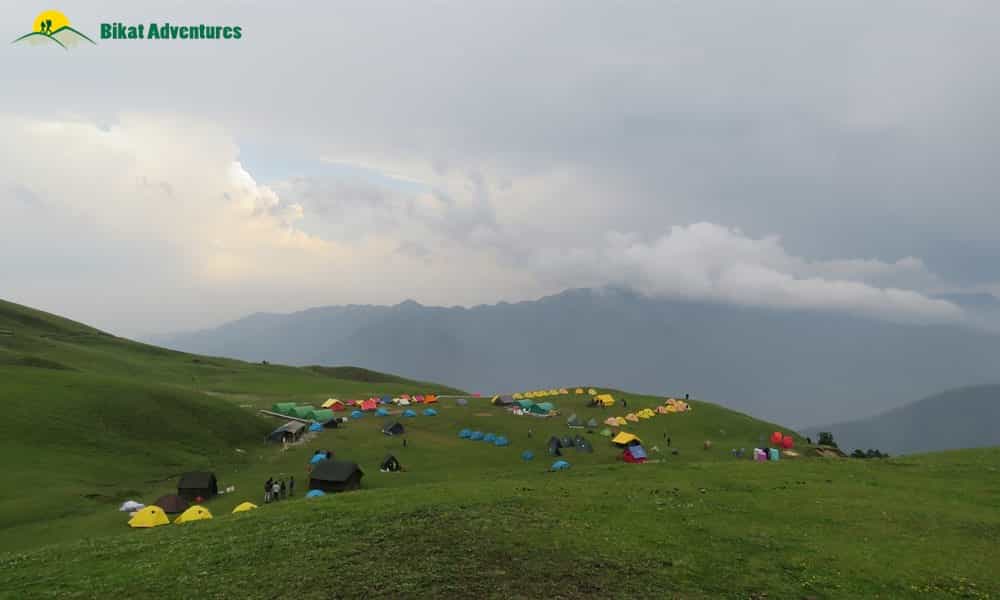
Fixed Camping, as the name implies, is when you fix tents at each campsite for the entire trekking season. This has become a common practice since the advent of mass trekking in the Himalayas.
In this style of camping, trekkers check into their tents at a campsite and then check out the next morning to proceed to the next campsite. A fixed camping model saves the additional time, energy and cost that goes into pitching tents, removing them and carrying them (along with food ration + resources) from one camp to the next.
This practice is not only lazy but also goes against the spirit of trekking and is harmful to the environment.
Read: Fixed Camps? That’s not the way to roll
In the Himalayas, you will often come across fixed camps set up by trekking organisations on popular trails like the Hampta Pass, Har Ki Dun, Rupin Pass and Bhrigu Lake. Fixed camps were largely set up on Roopkund as well before the trek was banned entirely.
All these treks, if you notice, are predominantly meadow treks.
What this means is that once a tent is set up, the meadows/vegetation under the tent get no breathing space or access to sunlight for a good portion of the year.
We will leave it to you to piece the rest of the picture/devastation that follows when fixed camping is practiced on such trails.