Note: Ensure your socks are evenly stretched out and not clumped up anywhere. Sometimes, we have seen participants wear two layers of socks to keep their feet warm. Please avoid this as it could make your boots tighter. The resulting abrasion also causes some painful blisters and wounds.
Once your feet have been comfortably placed inside the foot, push the tongue loop back to its original position. This closes the ankle/shin section of the boot.
Ensure the tongue loop is placed against your shin and sits at the centre of the boot. Check if the buckle flaps overlap.
Now with your heel on the ground and toe pointed slightly upwards, give the heel of your boot a couple of taps on the ground to drive your foot back.
Then, with the heel resting on the ground and toe pointed up at a 45-degree angle, begin securing the buckles.
Note: It should take some effort to secure your buckles in place. If your buckles slide into place easily, then your boots are too loose. If it takes a lot of effort to strap the buckles into place, then your boots are too tight. When you crank your buckles too tight, you will notice the plastic of your shoes deform a little. This is your cue loosen the buckles by a notch or two.
Once the buckles are strapped in, secure the power strap tight enough to match the snugness of the buckles at the top of your ski boot.
Your ski boot is now ready to be fitted into the ski.
Note: When removing your boot, follow the same process. Undo the power strap and the buckle, push the tongue outward, away from you to the side of the boot before pulling your foot out.
Some handy tips on the fit of your ski boot
The fit of your Ski Boot determines how well you can control your Ski.
When you stand up in your ski boots, the heels of your feet should brush the back of your boot and the toes should brush the front. There shouldn’t be enough room for your feet to slide back and forth or for your toes to wiggle.
When you flex forward into a ski stance, your feet must pull back slightly making more room in the front for your toes. You shouldn’t feel any pressure points when this happens.
The more snugly a boot fits around your foot, the better you will be able to control your ski.
Note: After a couple of runs, you may need to readjust the buckles and the power strap of your boots to maintain the snug fit.
How to fit your ski boots into your skis?
Your ski boots go into the Ski Bindings of your Ski. The length of your ski bindings can be adjusted to fit the boot using a tiny, metallic lever on the side.
Once you have worn your boots, place both your skis perpendicular to the fall line of the slope. When you place it perpendicular to the fall line, you will notice that the skis don’t slide down.
Note: In skiing, a fall line refers to the line that traces the steepest descent down a mountain, i.e, the path an object would take if it were free to move downhill under the force of gravity.
Next, ensure that the heel binding on both the skis are pushed down.
Gently scrub your boot back and forth on the heel binding to remove any excess snow clumped at the bottom of the boot before wearing your ski.
Once your boot is clean, insert the toe of your boot into the toe binding.
Standing on the tip of your toe, allow your heel to drop back into the heel binding until you hear a resounding click.
Your boot is not secured to your ski.
Tip: Wear the downhill ski first before clicking into the other one. This way, you can use the inner edge of the downhill ski to stabilise yourself on the slope before wearing the other ski.
How to remove your ski boots from your ski?
Clicking out of your ski boots is a relatively easy process.
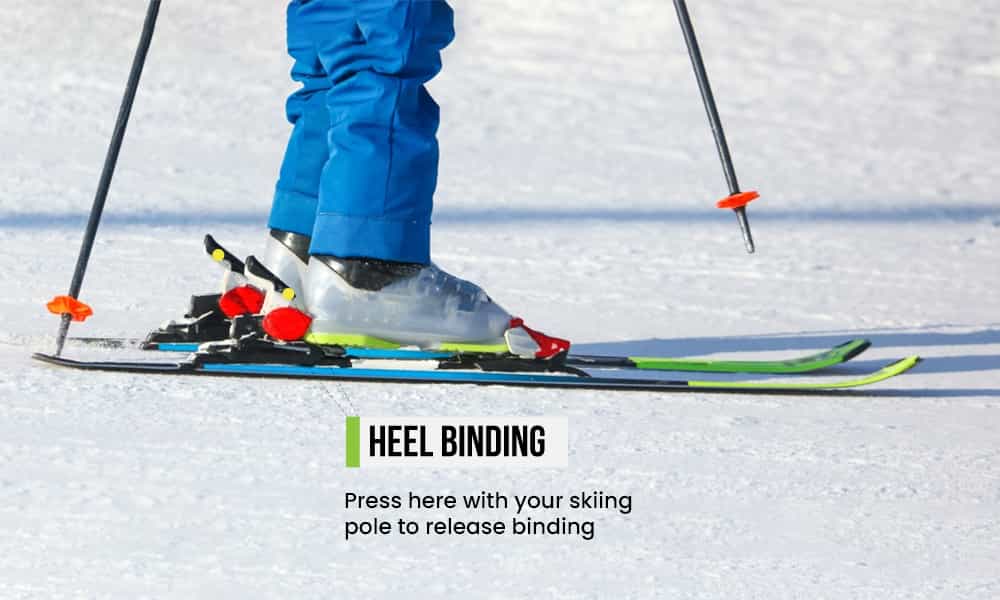
Use your ski pole to press into the little dimple on your heel binding.
Press down firmly until you hear a release.