Leave No Trace is built on seven core principles that have one common objective: they communicate the best possible way to enjoy the outdoors without causing much harm to the environment. The Seven Principles of Leave No Trace educates and guides recreationists to adopt sustainable methods that help them in leaving the outdoors as they found them. These Principles are the most robust and widely utilized minimum impact outdoor practices.
Although Leave No Trace has its roots in backcountry and wilderness, the practices have been adapted so that they can be applied anywhere - from the backcountry to local parks, to your backyard - and for any recreational activity. Each Principle covers a specific topic and provides detailed information for minimizing impacts.
In this article, we aim to provide you a brief understanding of all the LNT principles in the context of trekking in India-
We will begin with the first one.
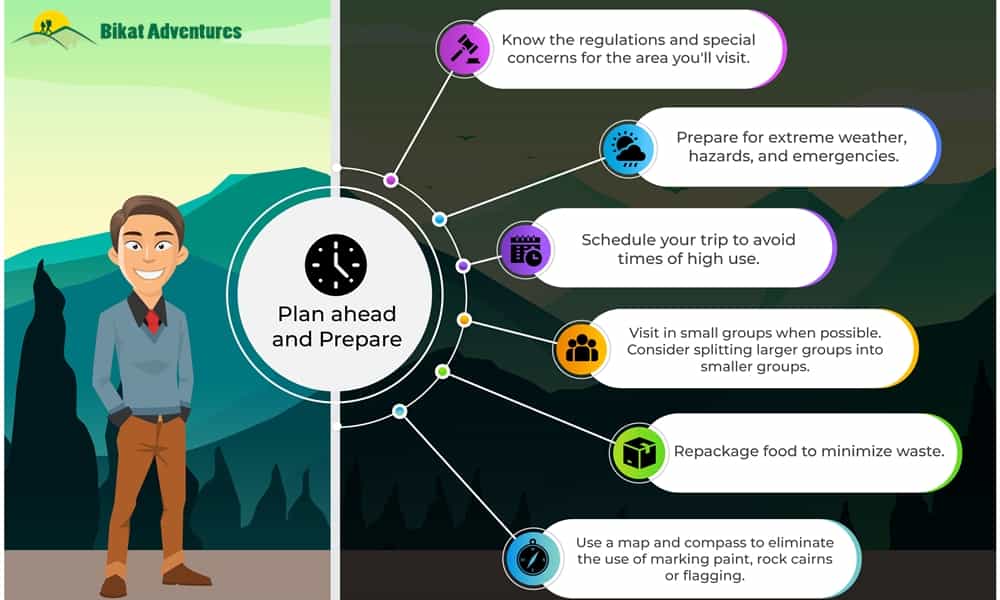
- Know the regulations and special concerns for the region you'll visit
- Littering, smoking, use of plastic are banned at almost every tourist destination and even if they aren’t officially banned - as a good outdoor enthusiast, one should avoid these things while on a trail. There are also certain regulations that are followed by some specific states, and it's equally important to know about them. E.g. – Night stay, camping, and campfire are banned in Pithoragarh, Uttarakhand, you should have an in-line permit to go sightseeing in Ladakh.
- While looking for regulations and special concerns in the place you are going to visit, pay special attention to local beliefs and customs. While these may not be officially sanctioned, it does well to be respectful of the traditions in the region. For example, in Sikkim, the left hand is somewhat considered to be cursed, and hence, people there avoid using it for lending money or greeting someone. In Ladakh, it is advised to stay at a distance from dogs (most of them are guard dogs for the domestic animals in the region) as they are not very friendly and might attack you. There have even been cases of dogs killing humans.
- Prepare for extreme weather, hazards, and emergencies.
- Weather, being one of the most unpredictable things, can ruin your whole trek if you aren’t prepared for it. In addition to this, high altitude peaks have reduced air pressure which makes it difficult for the body to adjust if you ascend too quickly from sea level. This is because your body does not get the amount of oxygen that it needs to get accustomed to the conditions.
- When you are training for a trek, you need to train for the one-off possibility of weather changes/hazards that might take place on the trail. Trek leaders at Bikat Adventures are prepared and trained to handle hazards and weather changes- but only a good fitness level can get you through these extreme conditions. The best way to prepare your body for lower levels of oxygen is to improve your VO2 max—the highest level of oxygen your body can consume. To do this, focus on your aerobic fitness by getting involved in running, cycling, and swimming.
- Also, Proper layering techniques can help you survive in these extreme conditions by maintaining your core body heat and by protecting you from cold air and freezing snow.
- Schedule your trip to avoid times of high use.
- If you can avoid treks that start on weekends or holidays. In one of our studies, we noticed that 74 % of our trekkers booked treks that started on a Saturday while 12.8 % of trekkers opted for treks starting on Sundays. Only a minuscule portion booked treks falling on weekdays.
Find out more: Over-crowded Himalayan Treks
- Heavier footfall adds more risk to the fragile ecosystem of the Himalayas. If you are looking for treks that are not crowded; consider avoiding famous, commercialized trails or embark on a trek during the off-season. This helps you as well as nature.
- Visit in small groups when possible. Consider splitting larger groups into smaller groups.
- More people result in more litter which puts a great amount of ecological stress on the environment. Water sources at campsites get polluted. The vegetation on the trail gets destroyed by so many people and mules walking over it.
- So, when booking a trek, look for Trek Operators who not only place a cap on group sizes but also limit the number of batches they take into a trail each season. Limiting group sizes is ineffective in the absence of caps on the number of batches. For example, at Bikat Adventures, the group sizes are capped at 15 members and the batch numbers are restricted to 180 per trail per season.
Read: How do you find out if a trekking organization is sustainable?
- Repackage food to minimize waste.
- You can repackage your food from plastic packaging to a more sustainable option that causes less impact on the environment. Plastic contains chemicals like lead, mercury, and cadmium that stick around in the environment for ages, threatening wildlife and spreading toxins, and also contributes to global warming.
- Maggi is one of the most commonly used foods in the mountains and we don’t deny that it tastes even better in the midst of the Himalayas. But, because of its plastic packaging, it causes a great amount of stress to nature. A research conducted by The Himalayan Cleanup, where more than 350 people from across the states participated in cleaning the Himalayas, revealed that 60% of the plastic waste was multi-layered food packaging that was non-recyclable. So, when you are in the Himalayan villages, opt for local options like Rajma Chhaawal or Dal Chaawal which are not only delicious but are great for the environment and health.
- Use a map and compass to eliminate the use of marking paint, rock cairns, or flagging.
- Marking paints, rock cairns, and flags are often used to mark trails but they cause harm to nature. Marking paints contain chemicals and toxic ingredients that emit harmful compounds. Building numerous rock cairns disturbs the soils and makes the area more prone to erosion and 1 or 2 flags used at certain distances can add up to a lot of trash.