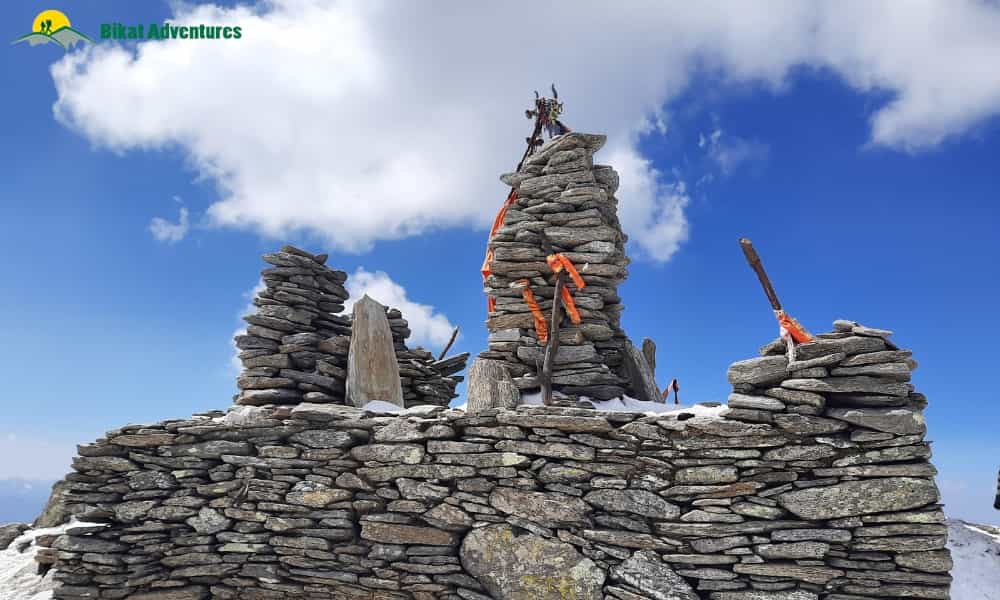
At the summit, there is a stone-sheeted shrine of Lord Shiva, which is surrounded by snow-covered mountains all around. A Trishul is planted on the shrine's ground, pointing upwards. Locals pay their respect at the shrine, and a small temple below is- also at the summit- that houses a statue of Lord Ganesha in peak summer every year. They believe that if the summer is very dry, laying Ganesha’s statue on the ground would bring rain.
According to the Kedarkantha legend, Lord Shiva sat at the summit to meditate but was disturbed by a bull, which was running below. So he went to Kedarnath, a town in Uttarakhand, to meditate afterwards.
Another local myth relates to the Pandavas, who went to the Himalayas to seek Lord Shiva’s blessings. However, he hid from Bheem and disguised himself as a bull. But, Bheem recognised him and went after him. So Shiva hid underground. When he rushed out from his hiding place, he let his body parts get divided, and each part fell at a different place. His throat fell on the Kedarkantha, thus earning the peak its name- transliteration- “the throat of Lord Shiva”.
The myth resembles the story of Panch Kedar, a set of five Shiva temples- Kedarnath, Tungnath, Rudranath, Madhyamaheshwar and Kalpeshwar- located in Uttarakhand’s Garhwal region. According to this legend, the Pandavas, on the advice of Lord Krishna, sought Lord Shiva to pardon them for their sins of killing their kin during the Mahabharata. But, Shiva was angry with them for their conduct and avoided them by taking the form of a bull and leaving for the Garhwal region.
The Pandavas sighted Shiva grazing as a bull in the hills of Guptakashi and tried to grab its tails and legs forcibly. However, the bull disappeared into the ground and later reappeared in the original form of Lord Shiva at five places- the bull's hump at Kedarnath, legs at Tungnath, face at Rudranath, stomach at Madhyamaheswar and hair at Kalpeshwar. It is believed that the Pandavas built five temples at these places.
Other major Himalayan peaks
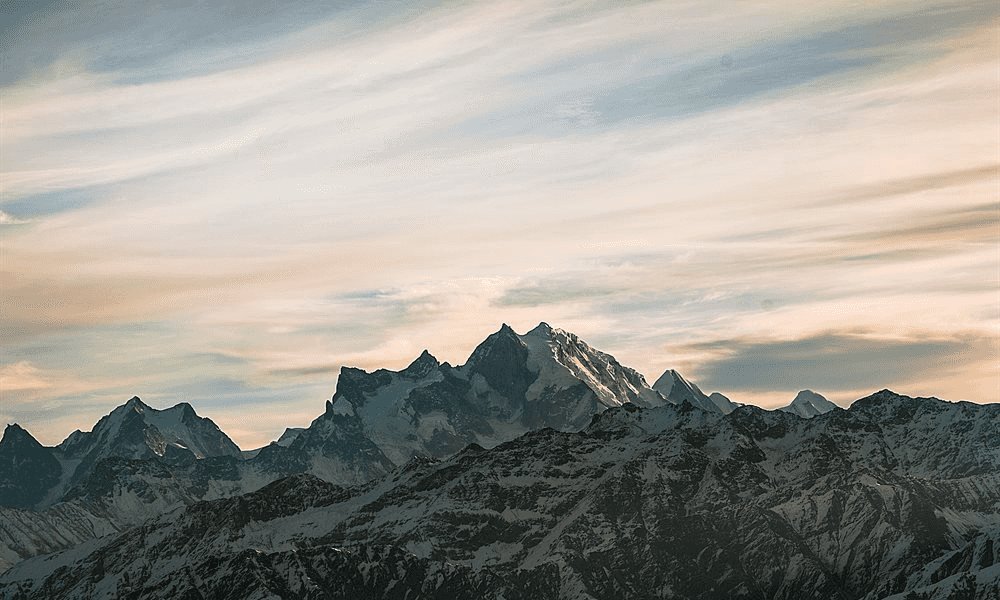
During the trek to the Kedarkantha summit, the Swargarohini peaks (at an altitude of over 20,000 feet) will be clearly visible. They are Swargrohini 1, 2, 3 and 4.