logo icon
  • Treks
    New Category
    • Kedar Kantha Trek
    • Har Ki Dhun Trek
    • Chopta Tugnath Trek
    • Beas Kund Trek
    Medium
    • Valley of Flowers Trek
    • Hampta Pass Trek
    • Sundakphu Trek
    • Goecha La Trek
    Hard
    • Chadar Trek
    • Stok Kangari Trek
    • Rupin Pass Trek
    • Pin Parvati Pass Trek
    image
    Choose your trek difficulty
    View All Treks
  • Expeditions
    New Category
    • New Link
    • New Link
    image
  • Skiing
    • Skiing
  • Why Bikat
  • Full On Travel
  • Blog
  • Shop
  • About

Pure Grit. Pure Adventure.

Bikat means difficult. But with us, that’s not a warning—it’s a promise. Of stories worth telling. Of adventures worth chasing.

Region

Month

Difficulty

Adventure Name

brand
  • Treks
    • Difficulty
      • New Category
        • Kedar Kantha Trek
        • Har Ki Dhun Trek
        • Chopta Tugnath Trek
        • Beas Kund Trek
      • Medium
        • Valley of Flowers Trek
        • Hampta Pass Trek
        • Sundakphu Trek
        • Goecha La Trek
      • Hard
        • Chadar Trek
        • Stok Kangari Trek
        • Rupin Pass Trek
        • Pin Parvati Pass Trek
    • Region
      • Uttarakhand
        • Kedar Kantha
        • Har Ki Dhun
        • Rupin Pass Trek
        • Valley of Flowers Trek
      • Himachal Pradesh
        • Hmpta Pass Trek
        • Beas Kund Trek
        • Pin Parvati Pass Trek
        • New Link
      • Ladakh
        • Chadar Trek
        • Stok Kangari Trek
        • Markha Vallery Trek
        • Lumayuru Trek
      • Sikkim
        • Goecha La Trek
        • Dzongari Trek
        • Greem Lake Trek
      • Bhrigu Pass Trek
        • Annapurna Circuit Trek
        • Langtag valley
        • New Link
    • Season
      • Summer (Apr-Jun)
        • Valley of Flowers
        • Hampta Pass Trek
        • Kedarkantha Trek
      • Monsson (Jul-Sep)
        • Sundakphu Trek
        • Goecha La Trek
        • Markha Valley Trek
      • Autumn (Oct-Nov)
        • Rupin Pass Trek
        • Pin Parvati Trek
        • Har Ki Dhun Trek
      • Winter (Dec-Mar)
        • Chadar Trek
        • Kedarkantha Trek
        • Chopta Tungnath Trek
    • Family Trek
      • Family Treks
        • Chopta Tungnath Trek
        • Har Ki Dun Trek
        • Beas Kund Trek
        • Bhrigu Lake Trek
    • Beginner Friendly
      • Beginner Friendly
        • Kedarkantha Trek
        • Hampta Pass Trek
        • Sandakphu Trek
        • Dzongri Trek
    • Off-beat
      • OFF-BEAT
        • Green Lake Trek
        • Lumayuru Trek
        • Lantang Valley Trek
        • Rupin Pass Trek
    • High Adventures
      • High Adventures
        • Stok Kangari Trek
        • Chadar Trek
        • Pin Parvati Pass Trek
        • Everest Base Camp Trek
    • Bikat Recommends
      • Bikat Recommends
        • Kedarkanth Trek
        • Valley of Flowers Trek
        • Goecha La Trek
        • Chadar Trek
    • Fresh Explorations
      • Fresh Explorations
        • Lamayuru Trek
        • Green Lake Trek
        • Langtang Valley Trek
        • Bhrigu Lake Trek
  • Expeditions
    • New Column
      • New Category
        • New Link
        • New Link
  • Skiing
    • Skiing
  • Why Bikat
  • Full On Travel
  • Blog
  • Shop
  • About
Whatsapp
Chat With Us
Pre Sale
Pre Booking - 8448680062
Post Sale
Post Booking - 9319028363 /8588878499
Email
Email - info@bikatadventures.com
Email
support@bikatadventures.com

Follow us on social media

Subscribe to our newsletter

Get the latest updates and offers.

Contact Us

Whatsapp
Chat With Us
Pre Sale
Pre Booking - 8448680062
Post Sale
Post Booking - 9319028363 /8588878499
Email
Email - info@bikatadventures.com
Email
support@bikatadventures.com

Company

About Us
Careers
Blog
Why Bikat

Support

Contact
Environment Policy
Privacy Policy
Terms and Conditions
Sitemap

Services

Treks
Mountaineering
Crossover Expeditions
Cycling
Bikat Experiences
Skiing
Custom

Mobile

Download on the
Apple Store
Get in on
Google Play
© 2026 Bikat Adventures. All Rights Reserved|Powered by: Novel Knett Software Solutions
Privacy PolicyTerms of Service
FacebookTwitterInstagram
Home
>
Blog
>
Understanding Acclimatisation
Informative

Understanding Acclimatisation

Rishabh Tiwari
Written by
Rishabh Tiwari
07 Jul 2023
0 views
0 comments
Understanding Acclimatisation

If you are familiar with the mountains, you are also familiar with the term ‘acclimatisation’. Adventure travel in the mountains is only made possible with our body’s ability to acclimatise and adapt to high altitudes. Acclimatisation plays a key role in mountaineering expeditions and could pretty much make or break your adventure! In this article, we delve deeper into the process of acclimatisation, its importance and when it is needed along with the risks in the absence of proper acclimatisation.


blog-image-0


Defining Acclimatisation, Load Ferry and Multi-Camp Expeditions

Before we get into the process of acclimatisation, it is important to be familiar with a few terms that will enhance our understanding of the topic. Let us start off by defining the term ‘acclimatisation’ itself. 

What is acclimatisation? Well to put it simply, it refers to the process by which our bodies adjust and adapt to environmental changes around us, allowing it to continue thriving in a range of different conditions. This adaptation happens quickly but it is important to give our bodies the required time and ensure that the changes in the environment are not drastic over a short period of time. This is extremely relevant in the context of mountaineering given that we gain significant altitude as compared to where we usually reside. As we go higher up, there is a drop in the levels of oxygen along with a drop in the air pressure around us. These changes could take a toll on our body, thus making acclimatisation of utmost importance on mountaineering expeditions.

Now that you have a basic idea of acclimatisation, let us try to understand what are multi-camp expeditions and the technique referred to as ‘load ferry’.

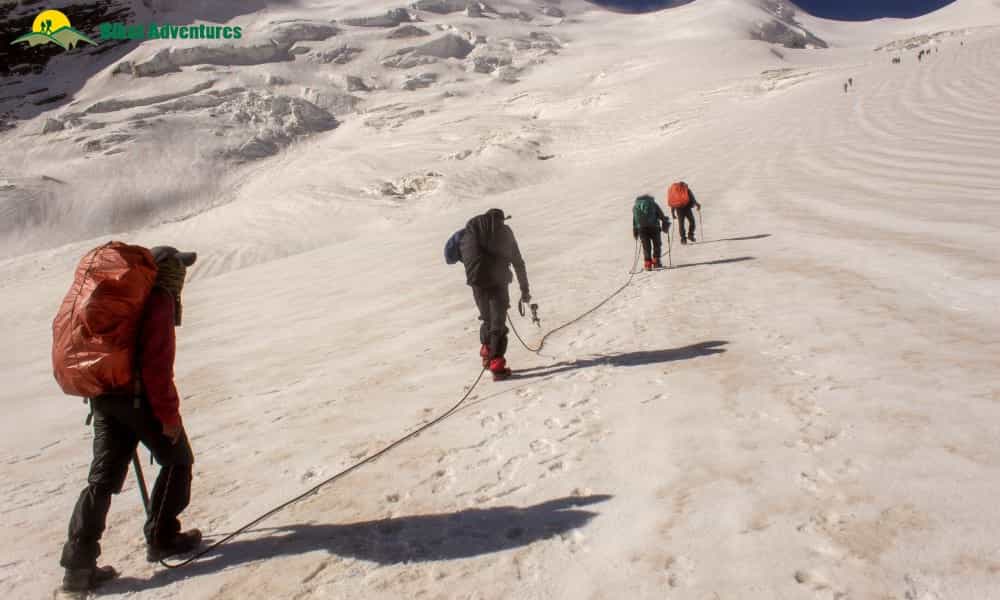
On mountaineering expeditions where the peak cannot be summited in a single day from the base camp, mountaineers set up additional camps. These are commonly referred to as multi-camp expeditions and are a popular style deployed on almost all major peaks around the world. Following this style of climbing also allows for proper acclimatisation given that the increment in the altitude is more gradual as compared to a steep change in altitude in single day summits. 

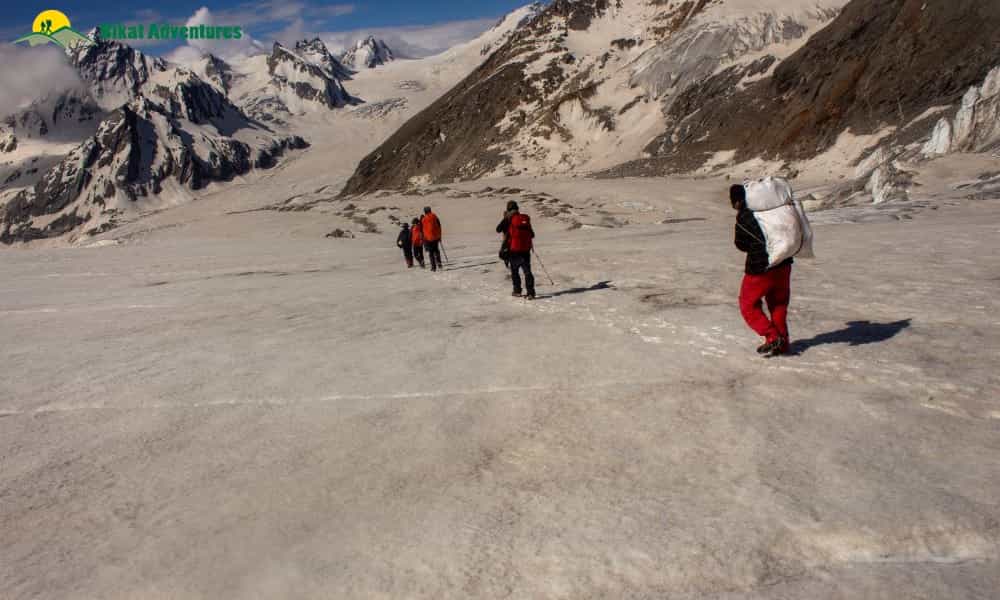
But how does one carry all their personal and common gear to these additional camps? This is where load ferrying comes in. Load ferrying is the technique of hauling up gear from a lower camp to a higher camp and repeating this process until all the gear is at the higher camp. Load ferry serves a two-fold purpose: one is that of getting all your essentials and ration up to the higher camp and two, is that of acclimatisation by following the golden rule of climbing which is ‘Climb High, Sleep Low’. You introduce your body to a higher altitude for a shorter duration before you set up camp there. This process is repeated till summit day and enhances the process of acclimatisation for mountaineers.


blog-image-0


Importance of Acclimatisation and When does it become Necessary?

With the decrease in air pressure in higher altitudes, there is also a drop in oxygen pressure. This means that you are inhaling lesser oxygen in a single breath. Given that oxygen forms the basis for our entire cardiovascular system, high altitudes deprive our body its main source of energy. This could cause life threatening problems if you do not allow your body to properly acclimatise to the change in altitude. Allowing for proper acclimatisation enables your body to make physiological changes that will facilitate an efficient absorption and processing of the limited oxygen you inhale. Deeper respiration, faster heart rate and breathing are a few of the changes you might notice. The body also starts to produce more red blood cells along with an enzyme that helps release oxygen from the red blood cells to the tissues. The body adapts itself in such a way so as to ensure sufficient oxygen supply to the tissues in your body. Without these bodily adjustments, it would be impossible to maintain your physical and mental health in the mountains, which inturn affects your ability to complete your expedition, thus making acclimatisation extremely important.

Each person’s body and physiological conditions react differently to changes in altitude, making it difficult to have a standard height at which acclimatisation becomes necessary. However, it can safely be said that there is no strict need for acclimatisation below 2400m. While it is always better to remain cautious, acclimatisation often becomes necessary a little further up where there is considerable drop in oxygen levels and air pressure.

Acclimatisation: Tips and Techniques

Although acclimatisation is a natural process, there are certain tips and techniques you can follow that will ease the process and allow your body to properly adapt.

1. Drink lots of water and keep yourself hydrated at all times. This aids the acclimatisation process and helps your body cope with the surrounding changes.

2. Consume energy giving food and avoid remaining hungry for long durations.

3. Avoid ascending too high too fast. One of the key principles of acclimatisation is to ascend slowly and avoid overwhelming your body. As a general rule in mountaineering, above 3000m, the increment in your sleeping altitude should be limited to 300-400m per day. Furthermore, for every 900m that you gain, you should take a rest day. Acustom your body to higher altitudes by climbing smaller peaks before attempting the bigger ones.

4. Climb high and sleep low. This phrase is commonly heard in the context of mountaineering. It refers to the process of climbing to a higher altitude during the day and returning to your camp at a lower altitude to rest for the night. This not only allows your body to adapt to a higher altitude but also gives it the much needed rest at night to regenerate. This is also possible in multi-camp expeditions which we read about earlier.

5. Load ferrying is an excellent way to acclimatise during a mountaineering expedition. The constant movement between camps with heavy loads trains your body to adapt to rigorous conditions and perform activities efficiently even when there are low levels of oxygen.


blog-image-0


Risks in the Absence of Acclimatisation

Improper acclimatisation or a lack of it leads to serious and even life-threatening health conditions. Given that medical help is not immediately available, it is best to follow proper acclimatisation principles and avoid any related illnesses. 

The following are a few major illnesses that could result from improper acclimatisation:

Acute Mountain Sickness (AMS)

AMS is common above 3000m and any mild symptoms that appear usually clear out after proper acclimatisation. However, persistent symptoms including nausea, vomiting, shortness of breath, headaches, fever, fatigue etc. should not be ignored. These could be signs of moderate or severe AMS. If you notice any of these symptoms, do not ascend any further until the symptoms resolve and descend to a lower altitude as soon as possible. 

High Altitude Pulmonary Edema (HAPE)

HAPE is a result of accumulation of fluid in the lungs. This fluid impairs oxygen exchange and leads to decreased oxygen in the bloodstream, causing impaired cerebral function and even death. Symptoms include persistent coughing accompanied by white froth, shortness of breath even at rest, fatigue, chest congestion, suffocation at night and irrational behaviour. A person affected by any of these symptoms must be immediately evacuated and provided medical attention.

High Altitude Cerebral Edema (HACE)

HACE results from fluid leakage that causes swelling of the brain tissue. Symptoms typically include psychotic behaviour, headaches, memory loss, hallucinations etc. Anyone suffering from these symptoms should be taken to a lower altitude immediately and must be evacuated at the earliest. 

While these are the major and most severe illnesses that could occur in higher altitudes, improper acclimatisation or the lack of it makes you more susceptible and puts your life at risk. It is always good mountaineering practice to follow safe procedures and allow ample time for acclimatisation. If you wish to know more or have any queries pertaining to acclimatisation and its key principles, feel free to reach out to our team.


 

Share
Prev
Basic Mountaineering Gears and Their Uses
All blogs
Next
Who Should Travel To Northeast India

Leave a Reply

Your email address will not be published.

Max 5 images, total size 3MB
Preview images

Related content

Discover these similar Blogs

10 Mountain Features Every Trekker Should Know: Master the Lingo of the Himalayas

10 Mountain Features Every Trekker Should Know: Master the Lingo of the Himalayas

02 Apr 2026
Kedarkantha vs Dayara Bugyal: The Ultimate Winter Trek Showdown

Kedarkantha vs Dayara Bugyal: The Ultimate Winter Trek Showdown

01 Dec 2025
Skiing in Kashmir: A No-Nonsense Guide to the Gulmarg Skiing Scene

Skiing in Kashmir: A No-Nonsense Guide to the Gulmarg Skiing Scene

09 Nov 2025
Go Nuts November — Official Explainer (How to Enter + Win)

Go Nuts November — Official Explainer (How to Enter + Win)

31 Oct 2025
Gulmarg vs Auli: Where to Learn Skiing in India  (An Honest Guide for 2025)

Gulmarg vs Auli: Where to Learn Skiing in India (An Honest Guide for 2025)

31 Oct 2025
Sleeping Bags that Actually Work in the Himalayan Winters (Not Just on Websites)

Sleeping Bags that Actually Work in the Himalayan Winters (Not Just on Websites)

27 Oct 2025
Snowfall Areas in India You Can Actually Trek Through

Snowfall Areas in India You Can Actually Trek Through

19 Oct 2025
Skiing in India: All You Need to Know Before You Hit the Slopes This Winter

Skiing in India: All You Need to Know Before You Hit the Slopes This Winter

10 Oct 2025
Trekking in Winter: Why Winter Trails Are a Different Kind of Magic

Trekking in Winter: Why Winter Trails Are a Different Kind of Magic

08 Oct 2025
Snow Trekking Shoes in India: What Actually Works on the Himalayan Trails

Snow Trekking Shoes in India: What Actually Works on the Himalayan Trails

08 Oct 2025

Popular tags

Explore more categories and themes from the same trail journal.

March

March

0 treks
April

April

0 treks
Skiing Courses

Skiing Courses

4 treks
May

May

0 treks
June

June

0 treks
Kayaking Courses

Kayaking Courses

0 treks
July

July

0 treks
6000M+ Peaks

6000M+ Peaks

1 treks
Nepal Treks

Nepal Treks

6 treks
Offbeat Treks

Offbeat Treks

26 treks
Scuba Courses

Scuba Courses

2 treks
August

August

0 treks
Wild Life Treks

Wild Life Treks

2 treks
Winter Treks

Winter Treks

28 treks