Your choice of trekking shoes can make your trek a blissful or blister-full experience based on how well it fits you. A good pair of trekking shoes is the most essential piece of equipment you will use while hiking.
Given the variety and multitudes of choices we have in the market these days, we asked Sarthak, our Exploration Leader (former) to guide us on how to go about choosing one. In this article he answers with winsome detail all the questions we had on how to choose the perfect pair of trekking shoes.
So, where does one begin when it comes to choosing trekking shoes?
As you already know there are a variety of shoes in the market these days. So, when it comes to choosing trekking shoes, you don’t begin with the shoes first. Instead, you focus on the nature of the trek/hike for which you are buying your shoes.
What is the terrain like?
Is it a 1 day hike or a multiple day trek?
How much load are you likely to be carrying?
Are there river crossings to negotiate?
Which season will you be trekking in?
And so on and so forth…
Could you explain how we study the nature of a trek with some examples?
Sure, let’s pick some from our portfolio itself.
Simple treks like Nag Tibba or Dayara Bugyal have well-paved trails. Since they are 3-4 days long at most, you will only need to carry a lightweight backpack.
When we go a little higher up on our Rating Scale, we have weeklong treks like Rupin Pass, Kashmir Great Lakes and Goechala. The terrain is wilder and rougher, the duration is longer and backpacks are considerably heavier. The shoes may also need to be built for negotiating boulders, snow and river crossings.
And at the end of the spectrum, we have our full-stride mountaineering expeditions. The duration is the longest, backpacks are at their heaviest and there are all sorts of terrain to negotiate. Glaciers, wide open crevasses, scree, moraine, you name it and you have it.
If you think about it, our trekking shoes are the one equipment we spend the most time in while on a hike. So, the nature and rigour of the trek and the load you will be carrying, which ultimately falls on your shoes, are crucial factors to keep in mind while buying one.
Thank you, that was quite insightful. Now, say we have narrowed in on the nature of the trek, what do we do next?
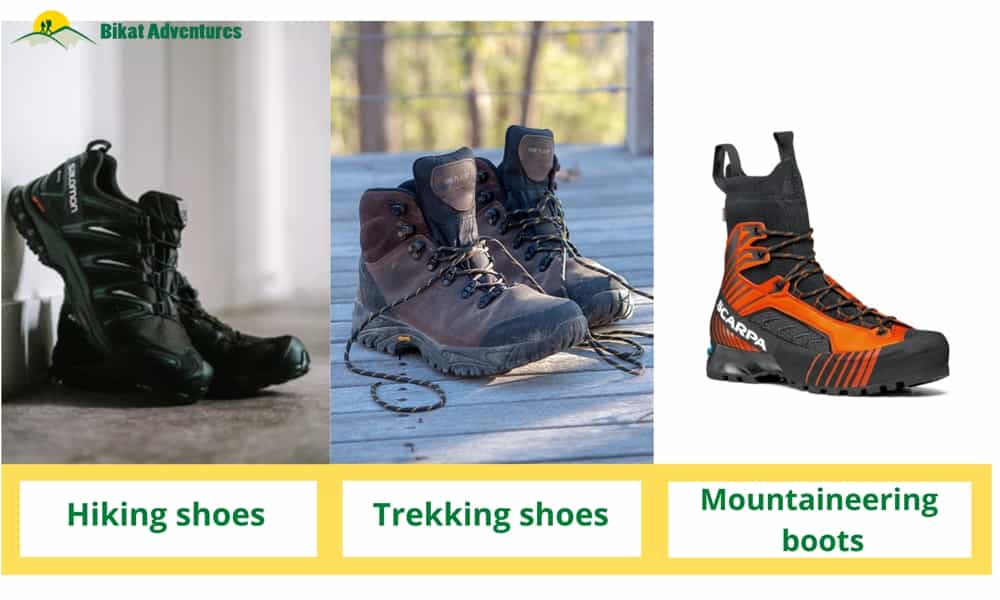
According to your need, there are different types of trekking shoes available in the market. Broadly speaking, we have three kinds.
- Hiking shoes: They are low-cut models with flexible rubber soles. These are lightweight and offer only minimal support to the ankle. So they are perfect for easy hikes (1-4 days long) with well paved trails.
They are easily available in the range of INR 2000 to 3500 from regular brands like Woodland, Wildcraft, Himgear, and Quechua. Other brands like Columbia, etc. are costlier but have different useful features.
- Trekking Shoes: Trekking Shoes are higher cut versions of hiking shoes. This is the category you require for the Himalayan treks. They are water-resistant, mid-rise ankle trekking boots that are made with stiffer construction to provide you with more ankle support and protection on rougher terrains.
This is the category needed for most of the Himalayan treks. The shoe is available in the range of INR 3500 to INR 6500 from regular brands like Wildcraft, Himgear, and Quechua. Other brands like Columbia, etc. are costlier but have additional useful features.
- Mountaineering boots: Mountaineering boots are big, burly, and stiff to withstand any gnarly terrain or weather. The high-rise ankle is more robust and suitable for challenging mountaineering expeditions which require technical climbing and negotiation over crevasse ridden glaciers, vertical ice walls, narrow ridgelines in extreme weather conditions. The high rise support prevents twisting and spraining of ankles. They also have an extra layer of insulation to protect your feet from frigid temperatures.
These are technical boots and should be purchased only by professionals. These may be required on some of our challenging mountaineering expeditions like Mt. Nun and Mt Satopanth but these are available on rent for occasional use.