
logo icon
  • Treks
    New Category
    • Kedar Kantha Trek
    • Har Ki Dhun Trek
    • Chopta Tugnath Trek
    • Beas Kund Trek
    Medium
    • Valley of Flowers Trek
    • Hampta Pass Trek
    • Sundakphu Trek
    • Goecha La Trek
    Hard
    • Chadar Trek
    • Stok Kangari Trek
    • Rupin Pass Trek
    • Pin Parvati Pass Trek
    image
    Choose your trek difficulty
    View All Treks
  • Expeditions
    New Category
    • New Link
    • New Link
    image
  • Skiing
    • Skiing
  • Why Bikat
  • Full On Travel
  • Blog
  • Shop
  • About

Pure Grit. Pure Adventure.

Bikat means difficult. But with us, that’s not a warning—it’s a promise. Of stories worth telling. Of adventures worth chasing.

Region

Month

Difficulty

Adventure Name

brand
  • Treks
    • Difficulty
      • New Category
        • Kedar Kantha Trek
        • Har Ki Dhun Trek
        • Chopta Tugnath Trek
        • Beas Kund Trek
      • Medium
        • Valley of Flowers Trek
        • Hampta Pass Trek
        • Sundakphu Trek
        • Goecha La Trek
      • Hard
        • Chadar Trek
        • Stok Kangari Trek
        • Rupin Pass Trek
        • Pin Parvati Pass Trek
    • Region
      • Uttarakhand
        • Kedar Kantha
        • Har Ki Dhun
        • Rupin Pass Trek
        • Valley of Flowers Trek
      • Himachal Pradesh
        • Hmpta Pass Trek
        • Beas Kund Trek
        • Pin Parvati Pass Trek
        • New Link
      • Ladakh
        • Chadar Trek
        • Stok Kangari Trek
        • Markha Vallery Trek
        • Lumayuru Trek
      • Sikkim
        • Goecha La Trek
        • Dzongari Trek
        • Greem Lake Trek
      • Bhrigu Pass Trek
        • Annapurna Circuit Trek
        • Langtag valley
        • New Link
    • Season
      • Summer (Apr-Jun)
        • Valley of Flowers
        • Hampta Pass Trek
        • Kedarkantha Trek
      • Monsson (Jul-Sep)
        • Sundakphu Trek
        • Goecha La Trek
        • Markha Valley Trek
      • Autumn (Oct-Nov)
        • Rupin Pass Trek
        • Pin Parvati Trek
        • Har Ki Dhun Trek
      • Winter (Dec-Mar)
        • Chadar Trek
        • Kedarkantha Trek
        • Chopta Tungnath Trek
    • Family Trek
      • Family Treks
        • Chopta Tungnath Trek
        • Har Ki Dun Trek
        • Beas Kund Trek
        • Bhrigu Lake Trek
    • Beginner Friendly
      • Beginner Friendly
        • Kedarkantha Trek
        • Hampta Pass Trek
        • Sandakphu Trek
        • Dzongri Trek
    • Off-beat
      • OFF-BEAT
        • Green Lake Trek
        • Lumayuru Trek
        • Lantang Valley Trek
        • Rupin Pass Trek
    • High Adventures
      • High Adventures
        • Stok Kangari Trek
        • Chadar Trek
        • Pin Parvati Pass Trek
        • Everest Base Camp Trek
    • Bikat Recommends
      • Bikat Recommends
        • Kedarkanth Trek
        • Valley of Flowers Trek
        • Goecha La Trek
        • Chadar Trek
    • Fresh Explorations
      • Fresh Explorations
        • Lamayuru Trek
        • Green Lake Trek
        • Langtang Valley Trek
        • Bhrigu Lake Trek
  • Expeditions
    • New Column
      • New Category
        • New Link
        • New Link
  • Skiing
    • Skiing
  • Why Bikat
  • Full On Travel
  • Blog
  • Shop
  • About
Whatsapp
Chat With Us
Pre Sale
Pre Booking - 8448680062
Post Sale
Post Booking - 9319028363 /8588878499
Email
Email - info@bikatadventures.com
Email
support@bikatadventures.com

Follow us on social media

Subscribe to our newsletter

Get the latest updates and offers.

Contact Us

Whatsapp
Chat With Us
Pre Sale
Pre Booking - 8448680062
Post Sale
Post Booking - 9319028363 /8588878499
Email
Email - info@bikatadventures.com
Email
support@bikatadventures.com

Company

About Us
Careers
Blog
Why Bikat

Support

Contact
Environment Policy
Privacy Policy
Terms and Conditions
Sitemap

Services

Treks
Mountaineering
Crossover Expeditions
Cycling
Bikat Experiences
Skiing
Custom

Mobile

Download on the
Apple Store
Get in on
Google Play
© 2026 Bikat Adventures. All Rights Reserved|Powered by: Novel Knett Software Solutions
Privacy PolicyTerms of Service
FacebookTwitterInstagram
Home
>
Blog
>
Types of Mountaineering and Common Climbing Techniques
Informative

Types of Mountaineering and Common Climbing Techniques

Author
Written by
Bikat Adventures
06 Jul 2023
0 views
0 comments
Types of Mountaineering and Common Climbing Techniques

You might think otherwise but humans started scaling mountains pretty early in the historical timeline, especially given the lack of infrastructure and technology at that point of time. Documented examples of ascents or even just attempted ascents date as far back as 1336! Although attempts on the big guns, the Himalayas, only started later on, peaks in other mountain ranges across the world were being conquered. In 1786, the very first summit of Mont Blanc by Jacques Balmat and Michel-Gabriel Paccard marked the birth of mountaineering as a sport and is till date considered as an epochal event in mountaineering history. What initially started off for political, economic or religious purposes gradually evolved into a sport with defined techniques and specialised equipment made to support climbers. There was a growing desire to explore the natural world and unchartered territories, which fueled the growth of mountaineering.

 This article explores the different styles of mountaineering and common climbing techniques followed by mountaineers across the world along with some fun facts from mountaineering history!
 

blog-image-0


Styles of Mountaineering

Broadly speaking, there are two main styles of mountaineering; Alpine style and Expedition style.

Alpine Style

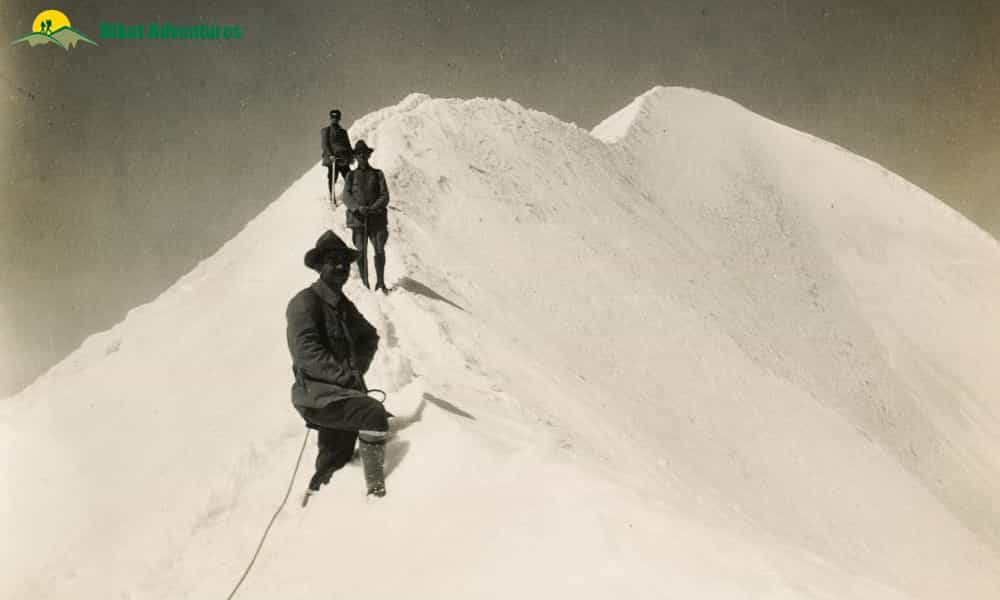
Alpine style or variations of it typically involves no backtracking, with a single and straightforward push to the summit. This means climbing with limited gear, food, ration and giving up on the comforts of warmth, sleep and nourishment to reach the top. The term ‘alpine’ originates from the Alps where in the 1800s, mountaineers climbed classic routes with one tent and a backpack on their back, and moved camps as they went up and down the mountain. Mountaineers following this style of climbing do not change camps if the summit can be reached in a single day. Given the pace of the ascent, alpine style of mountaineering leaves less time for acclimatisation. Supplementary oxygen is rarely used in this style and loads are restricted to a minimum to aid a fast ascent. Climbers rarely rely on fixed ropes (wherever avoidable), which are common in expedition style of mountaineering. All these characteristics also make it one of the most dangerous forms of climbing. This style of climbing is mostly suited and is also common on mid-sized mountains with an elevation ranging between 2000 m-5000 m and are located close to civilization, like the Rockies or the Alps.

Although alpine style climbing is not common in the Himalayas, mountaineers have successfully summited major peaks in the Himalayan range using this style. The Northwest face of Gasherbrum I was successfully climbed in pure alpine style by Reinhold Messner and Peter Habeler in 1975. This was also the first ascent of an 8000 m using alpine style, shattering the belief that they could only be climbed in expedition style. Years later, Nives Meroi and Romano Benet climbed all 14 eight-thousanders in alpine style, without any support or supplementary oxygen.


blog-image-0


Expedition Style

In a complete contrast to alpine style, expedition style involves carrying large quantities of equipment, food and ration up and down the mountain, while making slow progress towards the summit. Typically, expedition style of mountaineering has a big team of climbers along with porters and guides who support their climb. Mountaineers set up multiple camps along their route to the top and carry the loads from one camp to another over multiple rounds until all the gear and ration is at the higher camp. This process is referred to as ‘load ferry’ and is repeated until they complete their ascent. Load ferrying also acts as an excellent technique to ensure proper acclimatisation, thus reducing a climbers’ chances of developing altitude sickness. Climbers resort to fixed lines to avoid the dangers of frequent movement between camps. Expedition style involves the use of supplementary oxygen on the 8000 m mountains and is safer given the availability of food and equipment to survive a long lasting storm. However, the slow pace of this style and longer exposure to the dangerous terrain also puts climbers at the risk of other risks like avalanche and rockfall. 

Expedition style is highly suitable in the Himalayan ranges which are extremely remote and also present dangerous climbing conditions. To put things into perspective, while Mont Blanc was first summited in 1786, the first 8000 m peak was only successfully summited in 1950, which speaks volumes of the difficulty level involved in climbing an eight-thousander. Maurice Herzog and Louis Lachenal climbed the peak of Annapurna in 1950, making it the first recorded successful ascent of an eight-thousander. Most of the major attempts and successful summits on the 8000 m peaks have been carried out in expedition style. 

Expedition style can be further broken down into guided and self-supported. In a guided climb, climbers are accompanied by an operator or guide who organises the climb for them. Loads are carried with the help of porters and pack animals. They also provide equipment and gear on hire. Self-supported expeditions are carried out by climbers and mountaineers on their own after obtaining necessary permits. They carry their load and make their way to the summit pitching multiple camps on the way.


blog-image-0
blog-image-1


Common Climbing Techniques

Different terrains warrant the use of different climbing techniques and procedures. Following are a few common techniques used by mountaineers:

Rope Up

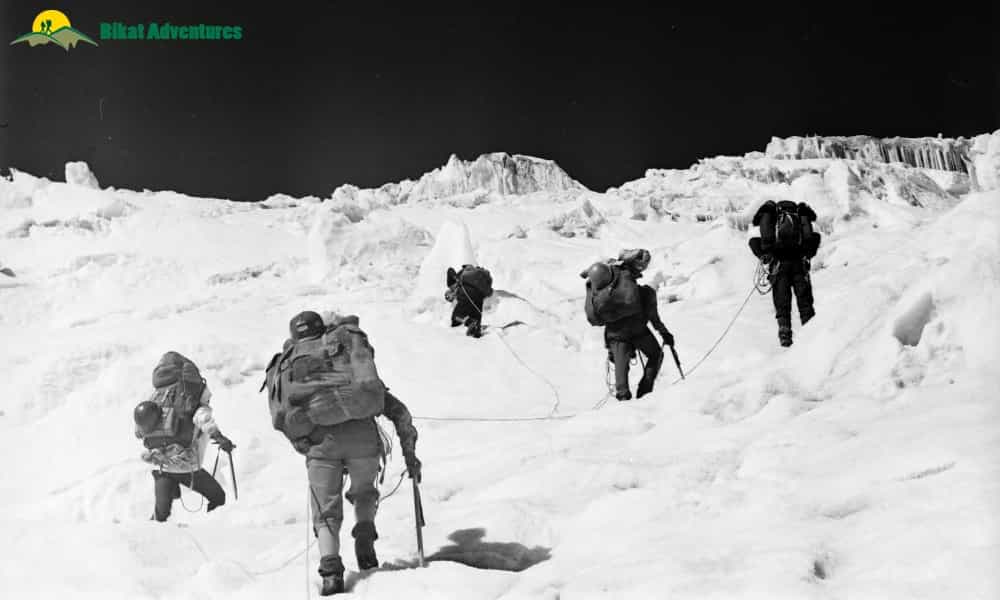
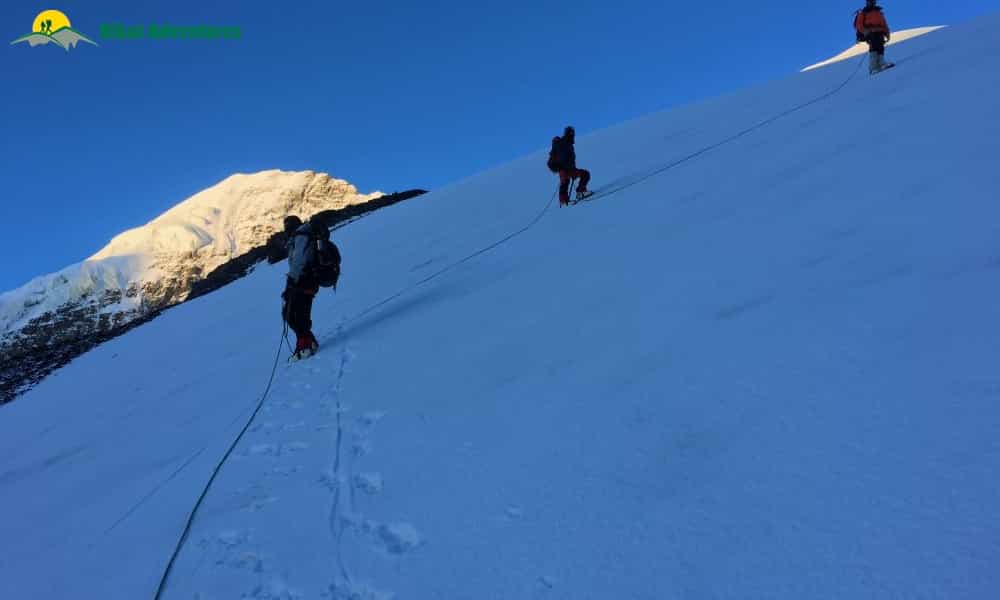
This technique refers to the process of roping up with other climbers for protection and safety while traversing on a glacier or a steep slope on the way to the summit. It acts as a safety mechanism if and when a climber slips and falls into a crevasse or down a slope by allowing the other climbers to self-arrest and act as an anchor. The team of climbers then work together to rescue the climber who has fallen. Roping up is common on terrain where a climber believes that they will not get the required protection from crampons and footwork. While deciding the order of the rope-up team, it is important to remember that the climber with least experience should be placed in the middle, the climbers with experience in navigation and route finding should be in the front helping traverse around crevasses and the biggest person in the team should be leading during the ascent and should be tailing while descending. When you are moving as a rope team, keep in mind to match the pace of your fellow climbers and avoid leaving slack or loose rope which will take longer to arrest in case of a fall.


blog-image-0


Fixed Ropes

Fixed ropes are used in expedition style mountaineering in steep and icy sections of a route. A group of mountaineering guides fix ropes for other climbers to use during their expedition. Static or semi-static nylon rope is secured to a sturdy piece of ice or rock on the mountain and climbers use it as a support system or as a ladder while they move up and down a particular section of the mountain. The use of fixed ropes provides a safety mechanism to climbers on high altitude climbs where a small misstep could cost them their lives. Climbers attach themselves to the fixed line with a mechanical ascender, where the ascender cam locks onto the line in the event of a fall. All guided expeditions to the eight-thousanders set up fixed lines for climbers on steeper sections of the route. For example, the use of fixed lines is common at Hillary Step on Mt. Everest. Hillary Step is an extremely technical portion of the mountain that results in a bottleneck of climbers right below the summit. Today, the guides and Sherpas of Nepal who carry loads and fix ropes play a crucial role and are pretty much the backbone of mountaineering in Nepal. Without them, expeditions of numerous mountaineers would be impossible.


blog-image-0


Aid Climbing 

Aid climbing involves the use of specialised equipment on extremely steep and long routes that demand high levels of endurance and stamina. During a climb, aid climbers place protection equipment in the cracks or other features of a rock or ice, then clip a stirrup, which is a ladder-like device to the protection equipment and pull themselves up with the help of the stirrup or aider. This process is repeated to progress upwards on a steep mountain slope. Until the 1940s, pitons were typically used as protection equipment which were screwed into the cracks with a hammer. With the development in mountaineering gear and technology, mountaineers today use a wide array of equipment including copperheads, camming devices, ascenders, and nuts along with pitons. While aid climbing was normal practice until the 1960s, mountaineers including Reinhold Messner criticised the use of aid, stating that the development in climbing techniques and equipment allowed for aid free climbing and the continuing use of aid went against the spirit of mountaineering. Currently, a number of routes that were earlier climbed using aid climbing are being climbed free by climbers with improvised techniques, equipment and remarkable physical abilities.


blog-image-0


These styles and techniques of climbing were not developed overnight or over a single attempt to scale a mountain. The evolution of modern day climbing, techniques and equipment took place over hundreds of years with climbers trying and testing different styles and methods to efficiently summit a mountain. In this process, there were attempts that ended in success and also attempts where a number of mountaineers lost their lives. K2, also known as the world’s deadliest mountain, for its ruthless and unforgiving weather conditions, was only summited in 1954 by an Italian team. Lino Lacedelli and Achille Compagnoni reached the summit of K2 after numerous unsuccessful attempts by mountaineers across the world. The mountain is also known to have taken the lives of many mountaineers and poses long technical stretches for a climber to tackle. In this period of evolution, a few mountaineers also attempted what was thought to be impossible and set a new record in the history of mountaineering. Reinhold Messner became the first person to scale all 14 eight-thousanders without the use of supplementary oxygen. It is no easy task to have climbed all of them when equipment and techniques were still being developed and understood by a majority of the climbers. 

Sometimes styles and techniques are mixed together by mountaineers to achieve optimal outcomes or even as safety procedures. The sport continues to evolve with the technological developments that produce better equipment resulting in more efficient and easier techniques for climbing. This also means that mountaineering has now become accessible to everyone and scaling Mt. Everest is no longer associated with the wow factor it once was given the rate at which operators are taking climbers on guided expeditions. This has also led to increased waste accumulation on the mountains, either in the form of plastic or fixed ropes left by climbers season after season. Regardless of your choice of expedition style or climbing techniques, it is important to climb these mountains in a sustainable and eco-friendly manner. 

If you wish to know more or have any queries regarding mountaineering styles, techniques or maybe even some history, feel free to reach out to our team.

Share
Prev
Things to Do in Geneva
All blogs
Next
Things to Remember for a Self Guided Expedition

Leave a Reply

Your email address will not be published.

Max 5 images, total size 3MB
Preview images

Related content

Discover these similar Blogs

10 Mountain Features Every Trekker Should Know: Master the Lingo of the Himalayas

10 Mountain Features Every Trekker Should Know: Master the Lingo of the Himalayas

02 Apr 2026
Kedarkantha vs Dayara Bugyal: The Ultimate Winter Trek Showdown

Kedarkantha vs Dayara Bugyal: The Ultimate Winter Trek Showdown

01 Dec 2025
Skiing in Kashmir: A No-Nonsense Guide to the Gulmarg Skiing Scene

Skiing in Kashmir: A No-Nonsense Guide to the Gulmarg Skiing Scene

09 Nov 2025
Go Nuts November — Official Explainer (How to Enter + Win)

Go Nuts November — Official Explainer (How to Enter + Win)

31 Oct 2025
Gulmarg vs Auli: Where to Learn Skiing in India  (An Honest Guide for 2025)

Gulmarg vs Auli: Where to Learn Skiing in India (An Honest Guide for 2025)

31 Oct 2025
Sleeping Bags that Actually Work in the Himalayan Winters (Not Just on Websites)

Sleeping Bags that Actually Work in the Himalayan Winters (Not Just on Websites)

27 Oct 2025
Snowfall Areas in India You Can Actually Trek Through

Snowfall Areas in India You Can Actually Trek Through

19 Oct 2025
Skiing in India: All You Need to Know Before You Hit the Slopes This Winter

Skiing in India: All You Need to Know Before You Hit the Slopes This Winter

10 Oct 2025
Trekking in Winter: Why Winter Trails Are a Different Kind of Magic

Trekking in Winter: Why Winter Trails Are a Different Kind of Magic

08 Oct 2025
Snow Trekking Shoes in India: What Actually Works on the Himalayan Trails

Snow Trekking Shoes in India: What Actually Works on the Himalayan Trails

08 Oct 2025

Popular tags

Explore more categories and themes from the same trail journal.

March

March

0 treks
April

April

0 treks
Skiing Courses

Skiing Courses

4 treks
May

May

0 treks
June

June

0 treks
Kayaking Courses

Kayaking Courses

0 treks
July

July

0 treks
6000M+ Peaks

6000M+ Peaks

1 treks
Nepal Treks

Nepal Treks

6 treks
Offbeat Treks

Offbeat Treks

26 treks
Scuba Courses

Scuba Courses

2 treks
August

August

0 treks
Wild Life Treks

Wild Life Treks

2 treks
Winter Treks

Winter Treks

28 treks